Problem Description
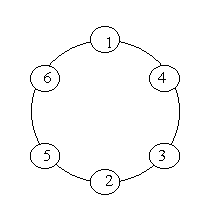
A ring is compose of n circles as shown in diagram. Put natural number 1, 2, ..., n into each circle separately, and the sum of numbers in two adjacent circles should be a prime.
Note: the number of first circle should always be 1.
Input
n (0 < n < 20).
Output
The output format is shown as sample below. Each row represents a series of circle numbers in the ring beginning from 1 clockwisely and anticlockwisely. The order of numbers must satisfy the above requirements. Print solutions in lexicographical order.
You are to write a program that completes above process.
Print a blank line after each case.
Sample Input
Sample Output
Case 1:
1 4 3 2 5 6
1 6 5 2 3 4
Case 2:
1 2 3 8 5 6 7 4
1 2 5 8 3 4 7 6
1 4 7 6 5 8 3 2
1 6 7 4 3 8 5 2
素數環:由1到n個數構成一個環,其中環內任意2個相鄰的數字之和是素數。
比較經典的搜索題,由于n<20,可以先預處理出前40個自然數中的素數,然后深搜某個位置的未被訪問過的數字和它相鄰位置的數字之和是否為素數,搜索退出的條件為最后一個位置的數字circle[n]+1是否為素數。一次搜索完成后,要回溯,否則只會輸出一組解。
 #include <iostream>
using namespace std;
const int MAXN = 41;
bool visit[MAXN];
int n,p[MAXN],circle[MAXN];

 void prime()
 {
{
 int i,j;
memset(p,true,sizeof(p));
for(i=2;i<MAXN;i++)
for(j=2;i*j<MAXN;j++)
p[i*j]=false;
 }
}
void dfs(int c,int cnt){

 if(cnt==n && p[circle[1]+circle[n]]){
for(int i=1;i<n;i++)
printf("%d ",circle[i]);
printf("%d\n",circle[n]);
 }
}
for(int i=c+1;i<MAXN;i++)
if(p[i] && i-c<=n && !visit[i-c]){
circle[cnt+1]=i-c;
visit[i-c]=true;
dfs(i-c,cnt+1);
visit[i-c]=false;
}
}
int main(){
int c=1;
prime();
while(scanf("%d",&n)!=EOF){
memset(visit,false,sizeof(visit));
printf("Case %d:\n",c++);
visit[1]=true,circle[1]=1;
dfs(1,1);
printf("\n");
}
return 0;
}